+86-173-0318-1768
- All
- Product Name
- Product Keyword
- Product Model
- Product Summary
- Product Description
- Multi Field Search

Views: 0 Author: Site Editor Publish Time: 2025-11-19 Origin: Site


Not every mill liner suits every mill. The grinding environment in a ball mill is vastly different from that of a SAG or regrind mill, and each requires its own engineering priorities. The liner is not just a wear surface — it shapes the charge motion, determines grinding efficiency, and affects downtime, safety, and maintenance cost. Choosing the right mill liner therefore directly defines your plant’s productivity. At Strudex, we design rubber and composite liner systems precisely tailored to your mill type, ensuring performance, safety, and efficiency in every operation.
Every grinding circuit has its own balance between impact and attrition. Coarse, high-energy duties such as SAG and AG milling demand liners that can absorb repeated impact from large rocks. Ball and secondary mills, on the other hand, rely on continuous attrition, which requires optimized surface profiles and material resilience.
Feed size and throughput targets also influence liner design. For instance, a coarse feed demands greater lift to promote cataracting, while finer feeds need smoother trajectories to maintain consistent energy transfer. Liner permeability — how easily slurry and fines can pass through — further affects mill efficiency and power draw. Poor liner selection can lead to over-grinding, blinding, or reduced discharge flow.
This is why Strudex engineers evaluate each mill’s geometry, charge behavior, and duty cycle before designing the ideal liner system. By matching liner hardness, thickness, and profile to the mill type, we help operators extend liner life while achieving the best possible grinding performance.
Ball mills operate under conditions dominated by attrition and cascading motion. Their liners are designed not only to protect the shell but also to lift the media to the right height for effective grinding. The choice of liner profile — wave, step, or lifter bar — determines how efficiently the balls tumble and how the energy is distributed across the mill.
In a ball mill, the height and spacing of the lifters directly influence impact points and energy dissipation. High lifters promote aggressive cataracting for coarse grinding, while lower profiles suit finer regrind applications. Wave liners, for instance, create smoother media movement and are ideal for uniform wear distribution.
Wear zones are another critical aspect. The feed end typically experiences more impact, while the discharge end faces higher abrasion from finer material. Strudex’s rubber liners are engineered with compound zoning — using harder rubber blends in impact zones and softer, resilient compounds where abrasion dominates. This custom layering ensures even wear, reduced noise, and extended service life.
Another priority in ball mill liner design is maintenance safety. Heavy steel liners can require cranes and pose serious ergonomic risks. Strudex rubber liners are up to 50% lighter than steel, allowing safer manual handling, faster installation, and reduced downtime. Our customers consistently report smoother relines and lower total maintenance costs thanks to this lightweight advantage.
Semi-autogenous (SAG) and autogenous (AG) mills face the most extreme impact conditions in mineral processing. The liners must endure the constant battering of large ore particles and steel balls, often weighing several kilograms each. For these mills, impact tolerance and structural integrity are top priorities.
SAG mill liners must balance lift and protection. If the lift angle is too high, the charge will be projected too forcefully, increasing shell stress. Too low, and grinding efficiency suffers. The right design maintains a steady cascade and consistent energy input across the mill length. Grate designs also play a vital role: efficient discharge grates prevent pebble accumulation and maximize flow-through, improving throughput.
Pebble flow management is another consideration. In many SAG mills, the buildup of pebbles can restrict grinding and reduce efficiency. Strudex’s engineered rubber lifter profiles and optimized grate apertures help control this flow, preventing blockages and maintaining a smooth discharge pattern.
Rubber liners for SAG mills were once seen as less durable than steel, but advances in polymer engineering have changed this view. Today’s Strudex rubber and composite systems can handle heavy impact and high energy input, offering excellent wear performance with less weight and noise. The result is a safer working environment and reduced mill stress — both key factors for continuous operation.
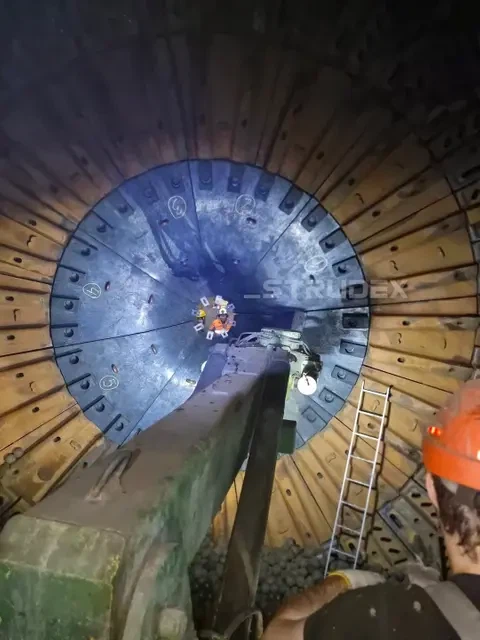
Regrind, fine-grind, and secondary mills work under very different conditions. The ore is finer, the media smaller, and the grinding action more uniform. In this environment, rubber liners have clear advantages over steel.
Noise reduction is one of the most noticeable benefits. Secondary milling operations often occur near plant areas where vibration and noise control are essential. Rubber’s natural damping ability significantly cuts noise levels, improving operator comfort and safety. Many plant operators report up to 50% noise reduction after switching to Strudex rubber liners.
Abrasion resistance is another strength. Fine particles in regrind circuits are extremely abrasive, and steel liners can polish quickly, reducing lifter effectiveness. Rubber liners maintain their surface grip and lifter geometry over time, sustaining consistent grinding performance.
Maintenance and safety also favor rubber. Lightweight panels allow smaller crews and faster changeouts, which means more uptime. Strudex rubber compounds are formulated for high elasticity and excellent wear resistance, maintaining liner shape and protection even under continuous abrasive contact. This combination of durability, safety, and acoustic control makes rubber the preferred solution for regrind and secondary mills worldwide.
Composite liners bridge the gap between the toughness of steel and the resilience of rubber. By integrating a steel backing plate with a molded rubber or polyurethane surface, they deliver exceptional structural support without sacrificing noise and safety benefits.
In high-impact areas like the feed end of large SAG mills, composite liners absorb shock efficiently while maintaining mechanical integrity. The steel component anchors the liner firmly in place, preventing deformation, while the rubber layer absorbs impact and abrasion. This dual nature allows longer service intervals and fewer unscheduled relines.
The cost-benefit balance is another reason composite liners are gaining ground. While initial investment may be higher than pure rubber, their extended lifespan and reduced downtime typically yield lower total cost of ownership. Strudex’s composite systems are designed for flexible configuration — combining steel inserts and rubber zones in proportions tailored to each mill’s conditions. This means operators can optimize both impact protection and maintenance convenience in one integrated system.
Composite liners are especially valuable in transitional mills, where grinding conditions vary along the length of the shell. By mixing materials and profiles strategically, Strudex engineers help clients achieve optimal performance throughout the mill’s duty cycle.
No two mills are exactly alike, and that’s where Strudex’s engineering approach stands apart. Rather than offering a one-size-fits-all product, we design liners through simulation, measurement, and trial-based optimization.
Our engineers use advanced 3D laser scanning and discrete element modeling (DEM) to analyze charge motion and liner wear patterns. This allows us to predict how different profiles and materials will perform before installation. Once the design is selected, our CNC machining centers and high-capacity vulcanizing systems produce liners with consistent precision and surface quality.
Strudex’s liner optimization program also includes on-site trials and performance audits. We measure liner wear, mill power, and throughput to confirm the simulation’s accuracy and identify further improvements. Through this data-driven process, we deliver tangible benefits: longer liner life, improved grinding efficiency, and lower total operating cost.
For mills operating in challenging ore conditions or remote sites, we also provide modular liner systems for easy transport and installation. Every liner — whether rubber, steel, or composite — is designed to integrate seamlessly into your maintenance plan, maximizing both uptime and safety.
Selecting the right mill liner is about aligning material, profile, and duty for each unique grinding application. From heavy-impact SAG mills to quiet, efficient regrind operations, the correct liner design determines wear life, efficiency, and worker safety. Strudex delivers tailor-made liner systems — rubber, composite, or hybrid — engineered through simulation and backed by decades of mineral processing expertise. To optimize your mill performance and extend equipment life, contact Strudex today for a professional liner assessment. Discover how our grinding liner systems can transform your operation — contact us to learn more.
Q1: How do I know which type of mill liner suits my grinding circuit?
The ideal liner depends on your mill type, feed size, and duty. SAG and AG mills require impact-resistant materials, while ball and regrind mills benefit from rubber’s abrasion resistance. Strudex can analyze your mill parameters and recommend the best solution.
Q2: Are rubber liners durable enough for heavy-duty mills?
Yes. Modern rubber compounds from Strudex are reinforced to withstand both impact and abrasion. Many large SAG and ball mills now operate successfully with rubber or composite liners, achieving long wear life and safer maintenance.
Q3: What are the main advantages of composite liners?
Composite liners combine steel’s structural strength with rubber’s flexibility and noise control. They deliver long wear life, reduced downtime, and improved operator safety, especially in variable-duty mills.
Q4: How does Strudex customize mill liners for clients?
We use digital simulation, on-site measurement, and operational data to design liners precisely suited to your mill and ore type. Every Strudex liner system is tailored to improve grinding performance, reduce downtime, and extend service intervals.


