+86-173-0318-1768
- All
- Product Name
- Product Keyword
- Product Model
- Product Summary
- Product Description
- Multi Field Search

Views: 0 Author: Site Editor Publish Time: 2026-11-26 Origin: Site


Many plant operators treat Trommel panels as simple, disposable commodities. They buy the cheapest option available. They install it quickly. Then they simply wait for it to break. This reactive approach destroys operational budgets. Incorrect screen media selection remains a primary driver of unscheduled downtime. It also causes poor material classification. When panels fail prematurely, your entire sorting line grinds to a halt. You lose valuable production hours. You risk missing strict product specifications.
This article provides a comprehensive framework for evaluating your screen media. We move past flashy marketing claims. We focus heavily on structural specifications, predictable wear life, and long-term financial returns. We assume you already possess a baseline understanding of trommel screens. Our specific focus here involves evaluating, pricing, and sourcing replacement screen panels effectively. By the end of this guide, you will know exactly how to match panel specifications to your specific operational demands.
Material dictates ROI: Polyurethane (PU) offers superior wear life for wet/abrasive applications, while rubber absorbs high impact, and steel wire maximizes open area.
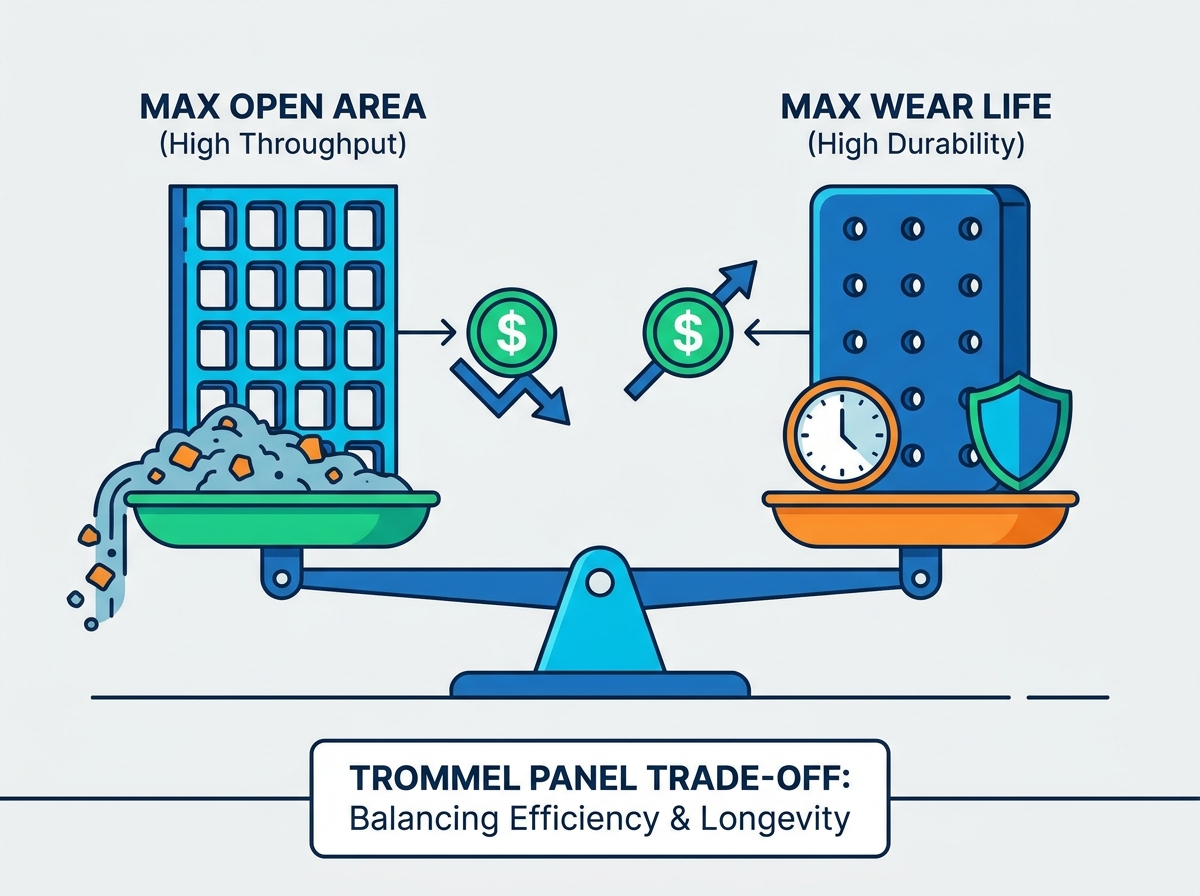
The "Open Area" Trade-off: Increasing a panel's open area improves throughput but inherently reduces its structural integrity and wear life.
TCO > Upfront Cost: Cheap panels often cost more due to frequent change-outs, lost production, and increased labor hazards.
Modularity is the standard: Modern operations are shifting to modular panel systems (e.g., pin and sleeve) to replace high-wear zones without discarding the entire screen.
Trommel efficiency requires a delicate balancing act. You must constantly balance throughput against screening accuracy. Throughput measures your tons per hour. Accuracy ensures you meet strict product sizing requirements. If you push material too fast, screening accuracy drops significantly. If you screen too carefully, production bottlenecks occur. Your screen media directly controls this critical balance.
Operators frequently battle pegging and blinding. Pegging happens when near-size particles wedge tightly into the panel apertures. Blinding occurs when sticky fines coat the screen surface completely. Both issues effectively reduce your open area to zero. When open area disappears, screening stops entirely. Material simply rides over the debris and exits the drum unscreened. You must shut down the plant. Your crews must enter the drum to clean it manually.
This manual intervention creates a massive downtime multiplier. Stopping a mill or sorting line costs money every single minute. You pay idle crews. You burn fuel. You lose out on direct revenue. Replacing prematurely worn panels adds severe labor costs to your balance sheet. The financial damage scales rapidly during an unplanned outage.
You can define a successful screen upgrade easily. A successful upgrade delivers a lower cost-per-ton processed. It provides highly predictable wear patterns. It maintains strict cut-size accuracy throughout the entire lifespan of the media. Achieving these metrics requires careful material selection.
Material selection defines your operational success. Every material offers distinct advantages. Every material also carries specific physical limitations. You must match the material chemistry to your exact feed profile.
Polyurethane (PU) excels in highly demanding environments. We use PU extensively for wet applications. It handles fine to medium screening beautifully. PU resists sliding abrasion far better than steel alternatives. However, PU possesses physical limits. It remains highly susceptible to damage from extreme heat. Sharp, heavy rocks can gouge the polymer surface. PU also tends to offer a slightly lower open area compared to thin wire.
Rubber absorbs heavy impact easily. We rely on rubber for coarse screening and primary scalping duties. It thrives in dry applications. Heavy boulders bounce off rubber safely. The downside? Rubber weighs considerably more than PU. It also blinds much faster in sticky or wet conditions. Rubber lacks the low-friction surface required for damp fines.
Woven wire and punched steel plate remain industry staples. They provide the absolute maximum open area. They withstand high-temperature environments effortlessly. Aggregate sorting relies heavily on steel. Unfortunately, steel suffers the shortest wear life in abrasive conditions. It rusts quickly. It pegs frequently. Steel also generates terrible noise pollution across your site.
Composite solutions bridge these historical gaps. Hybrid panels combine different materials cleverly. Steel-backed rubber blends severe impact resistance with rigid structural support. These hybrid designs offer operators the best of both worlds. They cost more initially but survive brutal feed conditions.
Material Category | Primary Advantage | Biggest Limitation | Ideal Application |
|---|---|---|---|
Polyurethane (PU) | Superior sliding abrasion resistance | Vulnerable to extreme heat | Wet applications, fine screening |
Heavy Rubber | Exceptional heavy impact absorption | Prone to blinding in wet clay | Primary scalp screening, dry feed |
Punched Steel | Maximum open area and throughput | Rapid wear and high noise | Aggregate sorting, hot environments |
Hybrid Composites | Combines rigidity and impact resistance | Highest initial acquisition cost | Extreme heavy-duty mixed feed |
Engineering specifications determine how your Trommel panels will behave underground or at the quarry. You cannot guess these numbers. You must calculate them precisely.
Aperture size and shape dictate everything. You must match the opening strictly to your material profile. Square apertures work well for standard aggregate. Slotted apertures handle wet, sticky clay much better. Round shapes offer precise cut points for specialized sorting. Teardrop shapes actively prevent pegging by allowing wedged rocks to fall free as the drum rotates. Proper shape selection ensures sharp cut points constantly.
Open area percentage evaluates your throughput capacity directly. The math is straightforward. You divide the total aperture area by the total panel area. More open area means higher volume passes through. However, physics demands a strict compromise. Manufacturers claiming maximum open area alongside maximum wear life are usually exaggerating. Thinner bridges between holes break faster. You must choose between longevity and immediate throughput volume.
Panel thickness and hardness matter immensely. We measure polymer hardness using the Shore A or Shore D scale. A softer Shore A rating flexes during rotation. This flexing action ejects stuck particles naturally. Thicker media is not always better. An overly thick profile creates deep holes. These deep holes easily trap near-size particles inside them.
Fastening mechanisms impact maintenance speed directly. Your fastening style dictates how fast crews can work safely. Consider the following modern fastening categories:
Bolt-on systems: These provide incredible security. Heavy rocks will not dislodge them. However, rusted bolts make manual replacement extremely slow.
Pin-and-sleeve systems: These represent the industry standard for modularity. You knock a polyurethane pin into a sleeve. It locks the panel instantly. They are fast and reliable.
Snap-in modules: These systems require no hardware. You simply hammer the panel onto a specially designed sub-frame. They offer the fastest swap times available.
Understanding cost requires looking far beyond the initial quote. Baseline cost drivers dictate the first number you see. Custom PU requires expensive initial mold fees. Steel pricing fluctuates wildly based on raw material spot prices. Overall dimensions dictate the raw material volume required. These factors create your baseline purchase price.
Smart operators calculate long-term value using a cost-per-ton model. First, you take the initial purchase price. Next, you add your installation labor costs. Finally, you divide this total sum by the exact tons of material processed before the part fails. This formula reveals your true operational expense. A cheap steel sheet often yields a terrible cost-per-ton ratio due to constant failures.
Hidden expenses drain budgets quickly. Storing massive steel sheets incurs high inventory carrying costs. They consume massive warehouse footprints. Modular systems use fewer, standardized parts. You can stack them easily. This saves precious warehouse space. Furthermore, heavy steel components require expensive cranes for safe change-outs. Modular polymers allow safe, manual replacement by a single worker.
You should expect realistic ROI timelines. Upgrading from cheap wire to molded polyurethane costs more upfront. The sticker shock surprises some buyers. However, you generally recoup this investment within three to six months. The extended wear life eliminates multiple maintenance cycles. Your production continues uninterrupted. This continuous production generates the revenue needed to offset the higher initial purchase price.
Upgrading your screening system carries distinct structural risks. You must evaluate frame compatibility carefully. A drum originally built for tensioned wire might not accept modular polymers directly. Substructure modifications are frequently required. You may need to weld new stringers onto the frame. Do not ignore these engineering requirements. Improperly seated modules will fly off during heavy rotation.
Uneven wear patterns plague most sorting operations. The feed end of your drum handles brutal, constant impact. Material crashes down aggressively. Therefore, the feed end always wears out much faster than the discharge end. You can mitigate this through intelligent rotation. Because modular panels are standardized, you can unpin them easily. Move slightly worn panels from the discharge end up toward the feed end. This strategy maximizes the total lifespan of every single piece.
Compliance and safety remain top priorities for plant managers. Switching from steel to rubber or PU drastically reduces ambient noise. Decibel compliance becomes a massive secondary benefit. OSHA regulations tightly control noise exposure limits. Polymers keep your site quieter and safer. Additionally, modular units weigh significantly less than full steel sheets. This keeps your maintenance crews well within safe manual handling limits. You reduce the risk of severe back injuries entirely.
Supplier selection separates good plants from great ones. Always ask about prototyping capabilities and custom molds. Does the supplier build custom tooling for unique aperture requirements? Avoid vendors who force you into generic, off-the-shelf sizes. Your feed material behaves uniquely. Your screen media should reflect those unique properties perfectly.
Prioritize extensive material testing. The best suppliers offer comprehensive on-site wear analysis. They visit your plant. They perform thorough material audits before recommending a specific polymer blend. They look at your drop heights, moisture content, and rock hardness. Never trust a vendor who quotes blind.
Scrutinize lead times and the overall supply chain. Overseas shipping delays can cripple your plant completely. If critical wear parts run out, you stop making money. Favor suppliers who maintain robust domestic stocking programs. Predictable manufacturing lead times keep you running smoothly. Ask your vendor to hold buffer stock specifically for your operation.
Your next step is simple and actionable. Walk out into your yard. Audit your currently discarded screen media. Look closely for uneven wear patterns. Check for severe pegging inside the holes. Note where the structural wire has snapped. Use this physical data as the strict baseline for your upcoming Request for Proposal (RFP). Real data empowers better purchasing decisions.
Screen media is never a simple set-and-forget commodity. It serves as an active, daily lever for strict cost control. When you optimize your screens, you optimize your entire plant's profitability. You stop wasting money on idle labor. You stop losing revenue to unscheduled breakdowns.
We strongly recommend prioritizing modularity and long-term cost-per-ton over the lowest initial bid. Upfront savings vanish instantly during your first unplanned outage. Smart engineering protects your plant uptime aggressively.
Audit your current discarded screen media today to identify failure trends.
Download a comprehensive specification checklist from your chosen supplier.
Request a professional on-site wear analysis to optimize your very next order.
A: Yes, it is highly recommended to use impact-resistant rubber at the feed end and high-open-area PU or wire at the discharge end.
A: Shift to slotted apertures, use softer/more flexible polyurethane panels, or add mechanical cleaning systems like brushes/water sprays.
A: Varies from 4 to 8 weeks depending on whether custom molds need to be fabricated; emphasize the importance of vendor stocking agreements.
A: Upfront, yes. But they drastically reduce maintenance costs because you only replace the 10-20% of panels that actually wear out, rather than scrapping a whole sheet.


