+86-173-0318-1768
- All
- Product Name
- Product Keyword
- Product Model
- Product Summary
- Product Description
- Multi Field Search

Views: 0 Author: Site Editor Publish Time: 2026-11-27 Origin: Site


Walk onto any modern material recovery site. You will see massive cylindrical drums sorting aggregate, compost, or waste. Industry professionals often use the terms "trommel screens" and "trommel panels" interchangeably. However, conflating the complete machine with its replaceable modular components causes significant friction.
Misunderstanding these terms leads to misaligned procurement requests. You might budget incorrectly for maintenance operations. Your facility could even face avoidable operational downtime. Teams often struggle to communicate needs clearly when terminology blurs the line between capital investments and routine wear parts.
This article provides operators and procurement teams a clear distinction between the overarching machinery and its screen media. You will learn the performance trade-offs of different materials. We also provide a practical framework for evaluating when to replace media versus upgrading the entire machine.
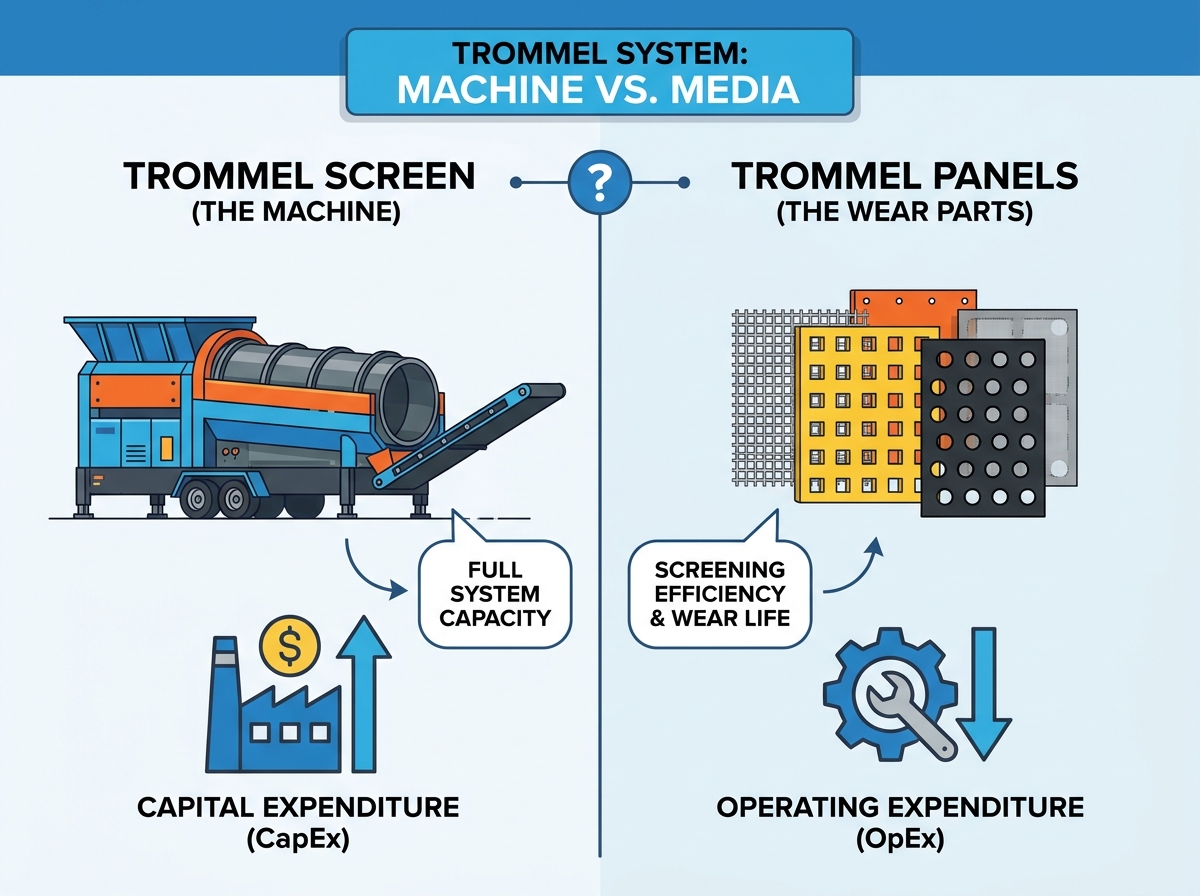
Trommel Screens are the complete, motorized capital equipment units (the machine) used for high-capacity material sorting.
Trommel panels are the replaceable, modular screen media (the wear parts) that attach to the trommel drum’s skeleton.
Procuring panels is an OpEx (operating expenditure) focused on wear life and open area optimization, while buying a trommel screen is a CapEx (capital expenditure) driven by throughput and site layout.
Upgrading to modular trommel panels can often revive an aging trommel screen's efficiency without the need for full machine replacement.
To optimize your sorting operation, you must first separate the overarching system from its consumable elements. Treating them as a single entity often masks underlying mechanical inefficiencies.
A trommel screen represents the complete mechanical assembly. It serves as the primary capital equipment on your site. This system includes the heavy-duty chassis, the feed hopper, the drive motor, and the rotating cylindrical drum skeleton. It requires substantial infrastructure, dedicated power sources, and regular mechanical servicing.
Its primary function focuses on tumbling and separating bulk materials by size. Operators rely on these machines to process heavy aggregates, municipal solid waste, wet compost, and construction debris. As the massive drum rotates, it lifts the feed material. Gravity then pulls the material back down. This continuous tumbling action stratifies the feed. It brings finer particles to the bottom of the material bed. These fines then find their way to the screen openings for proper separation.
In contrast, trommel panels are the specific, replaceable screening surfaces. They attach directly to the metal skeleton of the rotating drum. You can think of them as the consumable armor of your machine. They dictate the exact final cut size of your finished product. Manufacturers typically produce them from woven wire mesh, punched steel plate, or advanced synthetic media.
Their primary function involves acting as the direct physical barrier. They precisely allow undersized material to pass through. Simultaneously, they retain oversized material inside the drum for further processing or discharging. Crucially, they absorb the intense direct impact and severe abrasion of the feed material. By taking this constant punishment, high-quality media protects the expensive structural frame from catastrophic wear.
Selecting the right screen media requires balancing throughput demands against maintenance realities. No single material excels in every application. You must evaluate the distinct pros and cons of each option.
Traditional operations often default to steel options. They offer familiar performance characteristics and straightforward installation procedures.
Pros: Steel wire provides the maximum open area possible. This guarantees extremely high throughput rates. It also carries a significantly lower initial purchase cost.
Cons: Steel offers a much shorter wear life when processing abrasive materials. It also presents a severe risk of pegging and blinding. Wet, sticky clay will quickly clog wire mesh.
Synthetic media has transformed the screening industry. Operators increasingly favor polyurethane for challenging applications.
Pros: Polyurethane delivers exceptional wear life. It offers noticeable noise reduction on site. Furthermore, manufacturers mold tapered apertures into the design. These wider-bottom holes actively prevent near-size rocks from pegging.
Cons: The thick structural webs result in a lower open area percentage compared to wire. They also require a noticeably higher upfront capital investment.
Heavy-duty scalping operations demand extreme durability. Rubber steps in where other materials shatter or tear.
Pros: Rubber boasts unparalleled impact resistance. It easily handles massive boulders dropped from height. Its inherent flexibility creates a "trampoline effect" during rotation. This bouncing action actively sheds wet, sticky materials.
Cons: Rubber represents the heaviest media option available. It requires incredibly robust drum structural integrity.
Never default blindly to standard OEM issue media. You must actively match the panel material to your specific feed characteristics. Analyze the inherent abrasiveness of your rock. Test the average moisture content during different seasons. Measure the maximum drop height from your hopper. Highly abrasive granite demands thick polyurethane. Wet topsoil requires flexible rubber to prevent blinding. Clean, dry sand often runs perfectly fine on standard woven wire.
Material Type | Best Feature | Main Drawback | Ideal Application |
|---|---|---|---|
Woven Wire | Maximum throughput | Prone to rapid wear | Dry, non-abrasive sand and gravel |
Polyurethane | Anti-pegging properties | Lower open area | Abrasive aggregates and wet compost |
Heavy Rubber | Extreme impact resistance | High weight burden | Primary scalping of blasted rock |
When assessing your production bottlenecks, you must evaluate the overarching machinery. The finest screen media cannot compensate for an undersized or improperly configured machine.
Your site layout and contract types dictate the required mobility of your machine. Manufacturers design distinct chassis styles to meet these varied demands.
Tracked Units: These machines navigate rugged, uneven terrain effortlessly. Operators favor them for temporary quarry sites or remote land-clearing jobs. They crawl directly to the material pile, minimizing loader travel time.
Wheeled Units: Multi-site recycling contractors prefer wheeled chassis designs. You can hitch them directly to a semi-truck. They transport legally and easily down public highways between jobs.
Static Units: Permanent installations utilize static machines. They bolt securely to concrete foundations. They offer the largest drum sizes and highest total capacity for fixed recycling plants.
The physical size of the cylinder dictates your production ceiling. The drum length determines the material retention time. A longer drum gives the feed more opportunities to tumble over the apertures. This ensures a cleaner final product. Conversely, the drum diameter determines your total volumetric capacity. A wider drum handles thicker material beds without suffocating the separation process.
Engineers employ various methods to rotate these massive cylinders. Friction wheel drives use rubber tires pressing against the drum exterior. They offer simplicity and quiet operation. Chain drives utilize massive sprockets. They provide positive, slip-free traction for extremely heavy loads. Direct drives connect the motor directly to the central shaft. They offer compact power delivery. Each design carries profound implications for routine maintenance schedules and maximum torque limits.
You must honestly assess your total system capacity. Look beyond the screening surface. Consider the hopper feed rate. Evaluate the takeaway conveyors. Monitor the drive motor load. If your hoppers constantly bridge or your conveyors spill over, changing the media will not solve the bottleneck. Upgrading your trommel panels only works when the overarching machine can handle the target tonnage safely.
Facility managers face a common dilemma. Should they invest in better modular media, or replace the aging machine entirely? Making the wrong choice squanders maintenance budgets or ignores crippling structural flaws. Use this framework to guide your decision-making process.
Often, the core machinery functions perfectly, but the production output suffers. You can resolve these issues through a targeted operational expenditure.
Indicators: The machine itself runs smoothly. The drive motor shows no signs of strain. However, your screening efficiency has dropped noticeably. You see good material ending up in the oversize pile. Pegging is frequent, requiring workers to manually clear the holes. Alternatively, your current wire media simply wears out too fast, causing unacceptable downtime.
Action: Retrofit the existing drum with advanced modular synthetic media. Install modular polyurethane or rubber sections. This targeted upgrade reduces changeout downtime from days to mere hours. It dramatically improves cut accuracy. It solves blinding issues without replacing the expensive chassis.
Sometimes, the root problem lies deep within the equipment's architecture. Wear parts cannot fix structural or volumetric limitations.
Indicators: You discover visible structural fatigue in the drum skeleton. Welds crack repeatedly. You experience frequent, catastrophic motor or drive chain failures. Most importantly, your site's daily throughput requirements have permanently exceeded the machine's maximum volumetric capacity. The feed hopper overflows constantly.
Action: Initiate a formal capital procurement process. You must budget for a larger, more modern machine. A new unit will provide the necessary torque, volume, and structural integrity to match your newly scaled operations.
Always compare the financial impact of both paths before writing a purchase order. You must weigh the immediate out-of-pocket costs against long-term operational gains.
Evaluate the price of a custom modular panel conversion kit. Include the sub-frame adapters required for the retrofit.
Compare this figure against the heavy depreciation schedules of a brand-new machine.
Factor in the massive initial acquisition cost of new capital equipment.
Calculate the precise value of improved uptime. A panel upgrade often pays for itself within three months purely through regained production hours.
Execution determines the success of any equipment upgrade. You must navigate several mechanical pitfalls when modifying your screening setup. Careful planning prevents costly mid-installation surprises.
Ordering aftermarket media introduces dangerous compatibility risks. You face the danger of acquiring parts that do not perfectly align with your existing drum’s stringers and rolling rings. Every manufacturer spaces their internal ribs differently. If you order modular synthetic sections without measuring your drum precisely, the locking pins will not align. You will face days of custom fabrication to force the fit. Always conduct a thorough dimensional audit of your skeleton before purchasing aftermarket upgrades.
Labor requirements vary drastically between material types. Tensioned wire screens require significant labor to replace. Workers must maneuver awkward, heavy sheets inside a confined space. They often need cutting torches to remove rusted bolts. In stark contrast, modular pin-and-sleeve synthetic sections change out brilliantly fast. A single maintenance technician can swap an individual worn square in minutes. They simply knock out the pins with a mallet. This drastically reduces your weekend maintenance shifts.
Physics strictly governs your upgrade options. Upgrading from thin wire mesh to thick rubber panels significantly increases the rotational mass of the cylinder. Your drive motor must work much harder to spin this heavier load from a dead stop. Operators must verify the machine's technical specifications beforehand. Ensure your drive motor and gearboxes can handle the increased torque requirement. Overloading a weak hydraulic drive with heavy rubber media leads to immediate pump failure.
Understanding the distinction between capital equipment and modular wear parts transforms your maintenance strategy. You must optimize your trommel panels to solve frequent wear issues, severe blinding, and poor cut accuracy. Conversely, you must upgrade your overarching trommel screen to solve fundamental capacity limitations and structural fatigue.
To implement these insights, take immediate action on your site. Conduct a comprehensive wear audit on your current drum media this week. Document exactly where the worst abrasion occurs. Calculate the annual financial cost of your current changeout downtime. Armed with this accurate data, you can confidently request targeted quotes for either modular media kits or a larger capital machine.
A: Yes, you can retrofit almost any machine. However, it usually requires a one-time installation of a modular sub-frame. You must weld or bolt this adapter system directly to the existing drum skeleton to accept the pin-style synthetic media.
A: Lifespan varies drastically based on the material used and your specific feed abrasiveness. It ranges from just a few weeks for light wire processing abrasive granite, to well over a year for heavy-duty polyurethane handling compost.
A: High-quality aftermarket parts from specialized screen media manufacturers often outperform standard OEM parts. Specialized engineers can custom-design the aperture tapers and urethane durometer for your specific site challenges, rather than supplying mass-produced standard options.
A: Blinding typically stems from high moisture content and clay-heavy feed coating the surface. Pegging occurs when near-size rocks wedge tightly into straight-sided apertures. Switching to synthetic media with tapered relief angles usually solves both issues entirely.


