+86-173-0318-1768
- All
- Product Name
- Product Keyword
- Product Model
- Product Summary
- Product Description
- Multi Field Search

 |


Built for coarse screening in mines and quarries, Strudex hold-down rubber screen panels combine a one-piece rubber body with a bar-based fixing arrangement. The resilient surface takes contact from heavy feed while the hold-down system keeps the panel seated on its supporting deck. Two panel footprints and three thickness options make the configuration practical to specify against an existing installation, with hardness selected around impact, abrasion and the desired surface flexibility.
| Quantity: | |
|---|---|
Strudex hold-down rubber screen panels combine a one-piece impact-resistant screening body with a retaining-bar arrangement for coarse ore and quarry duties. The rubber receives particle contact and cushions impact; the hold-downs keep the panel seated on the deck. Two footprints, three thicknesses and two hardness options allow the physical section to be selected around the actual feed zone, screening openings and installed support geometry.
Parameter | Specification |
|---|---|
Panel type | One-piece rubber screen panel |
Material | Impact-resistant rubber |
Panel footprint | 610 × 590 mm or 610 × 610 mm |
Thickness options | 55 mm / 70 mm / 80 mm |
Rubber hardness options | 40 Shore A / 60 Shore A |
Fixing arrangement | Hold-down bars / skid-bar structure |
Screening duty | Primary screening and coarse separation |
Application | Mining, quarrying and aggregate production |
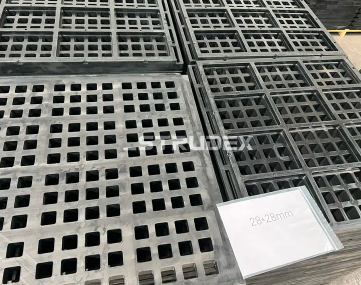
The working surface is consumed by rock contact, while the retaining system controls the panel’s position during vibration. Treating those functions together helps explain this panel’s value in coarse screening: a resilient face can accommodate repeated contact without relying on a loose or unsupported mat. The bars need their intended seating and contact areas, because retaining pressure applied in the wrong place can distort an edge instead of holding the panel as designed.
Impact response: rubber yields under contact and recovers as the load changes. This is useful where larger particles land on the screening face. Feed top size and drop height describe the impact duty more clearly than throughput alone, particularly when the incoming stream is concentrated beneath one chute.
Wear response: after landing, abrasive particles travel across webs and opening edges. The panel must retain enough working material in those locations while leaving a useful passage for the undersize. Surface thickness and opening condition therefore describe different parts of its remaining serviceability.
Restraint: the hold-down and skid-bar arrangement connects the consumable panel to the deck. Correct edge contact helps retain the intended screening surface and joint alignment. It also allows the wearing panel and the surrounding retaining components to be assessed separately when renewal is planned.
Configuration choice | What it changes in the application |
|---|---|
55, 70 or 80 mm thickness | Select the ordered thickness with impact exposure, aperture passage and the space available at the retaining bars. Increasing thickness changes the complete installed section and can affect how material approaches an opening. Check adjacent panels and joint levels when selecting a different thickness. |
40 or 60 Shore A | The 40 Shore A grade is softer and the 60 Shore A grade is firmer. Use that difference to evaluate surface response against impact, abrasive contact and lodged material. Neither hardness value independently defines tear resistance, usable screening area or a guaranteed operating interval. |
610 × 590 or 610 × 610 mm | These are separate footprints. The correct choice preserves the designed bearing area, clamping contact and joint position. Keep the full drawing with the footprint so a common 610 mm dimension is not mistaken for proof that the panels can exchange positions. |
Aperture layout | The required product and feed shape determine the useful opening arrangement. The rubber webs and retaining margins must carry the local contact duty, while apertures need access to the material being separated. Review opening area together with the surrounding solid section. |
A coarse deck can benefit from a wear-focused surface only while it continues to separate the required material. A thick bed may shield openings; enlarged apertures may change the undersize; an unintended edge gap may allow bypass. These are different process effects. Looking at both the product streams and the panel makes it possible to preserve the separation while selecting the appropriate wear section.
Feed contact zone: relate the selected thickness and rubber grade to the incoming trajectory and credible maximum particle. If contact is concentrated on one side, evaluate distribution as well as the panel. A uniformly heavy specification cannot redistribute the incoming stream by itself.
Working separation zone: consider the fraction close to the desired separation, particle shape and moisture. These influence how often material reaches an opening and whether it lodges there. Preserve the chosen aperture geometry when comparing changes in rubber grade or section.
Retained edges and joints: match the support and hold-down contact with the ordered panel. During a changeout, inspect these interfaces and confirm that adjoining surfaces form the intended path. This protects product control as well as mechanical seating.
The practical purchasing unit is a defined panel configuration at a named deck position. That links footprint, thickness, hardness, openings and retention without turning every wear location into a different product. It also allows usable panels to remain in service when a more heavily loaded position needs renewal, provided the deck’s intended assembly and replacement procedure permit that scope.
For approval, combine the dimensioned panel drawing with the hold-down arrangement and the required product grading. Verify the received thickness, openings and critical seating dimensions against that agreed configuration. Include feed distribution and current damage photographs in the enquiry so the chosen section addresses the actual coarse-screening duty rather than reproducing an unidentified failure.
Are the 610 × 590 mm and 610 × 610 mm panels interchangeable?
They are separate footprints and should be ordered against the deck drawing. The difference affects seating, joints and retaining-bar contact. Confirm the complete panel envelope, build height and hold-down arrangement before substitution, rather than assuming two panels with the same 610 mm dimension fit the same position.
Should I select 40 or 60 Shore A rubber?
The 40 Shore A option is softer; 60 Shore A provides a firmer surface. Choose between them using the actual impact, abrasion and blockage pattern. Hardness alone does not establish wear life, and the panel thickness, aperture layout and support conditions remain part of the decision.
Does choosing 80 mm thickness always improve performance?
The 80 mm option is one of the available configurations, alongside 55 and 70 mm. Select thickness around the load and installed profile. Added thickness can change the aperture passage and alignment with neighboring panels, so it should be reviewed with the openings and retaining hardware.
Why does a panel begin wearing around a hold-down edge?
Concentrated edge wear warrants a check of clamping contact, seating and the support beneath the panel. Also examine uneven feed loading and movement at adjacent joints. Record the location before replacing the board, so a retaining or support problem is addressed alongside the consumed rubber.


