+86-173-0318-1768
- All
- Product Name
- Product Keyword
- Product Model
- Product Summary
- Product Description
- Multi Field Search

Views: 0 Author: Site Editor Publish Time: 2026-11-28 Origin: Site


Incorrect screening equipment carries painfully high operational costs for any processing facility. Unplanned downtime drastically cuts into your daily revenue streams. Material contamination leads to rejected loads and frustrated customers. Reduced throughput fundamentally hurts overall site profitability. Many plant managers view the replacement of these components as a simple, recurring commodity purchase. Treating this decision like a generic buy is a costly mistake. It represents a strategic choice balancing wear life, screening efficiency, and maintenance overhead.
Every operation faces unique environmental challenges dictated by material behavior. There is no universally perfect screen for every job on the market. In this guide, we help you navigate these complex operational variables. You will learn how to properly align material composition, aperture geometries, and your specific environmental demands. Optimal selection drives consistent production and prevents daily maintenance headaches. Upgrading your Trommel panels requires a solid understanding of these foundational principles.
Panel material (polyurethane, rubber, woven wire, punched plate) dictates the critical trade-off between open area capacity and wear resistance.
Aperture shape must be matched to feed characteristics to mitigate pegging (wedging of near-size particles) and blinding (coating by wet/sticky materials).
Feed material density, drop height, and moisture content are the primary baseline metrics required before shortlisting panel specifications.
Identifying failure modes is the first crucial step toward optimization. Operators often accept poor performance as a normal operational reality. This acceptance severely limits plant efficiency and reduces profit margins. Rapid wear typically shows up as thinning screen surfaces or broken wires. Structural deformation manifests as sagging, dented, or warped sections across the drum. Off-spec product outputs indicate wrong-sized materials are slipping through damaged openings. These symptoms clearly highlight mismatched equipment struggling against harsh feed conditions.
The pegging versus blinding distinction requires your careful attention. Pegging occurs when hard, jagged particles physically lodge inside the screen apertures. These wedged stones permanently block other materials from passing through. It drastically reduces your available open area over time. Blinding describes wet, cohesive materials forming a thick surface film. Wet compost, clay, or topsoil coats the screen surface entirely. Both problems ruin your sorting accuracy and choke your daily production rates.
You must establish clear success criteria before purchasing replacements. A successful upgrade delivers easily measurable results for your plant. You should look for increased tons-per-hour processed during standard shifts. You want a significantly reduced frequency of physical swap-outs. Tighter cut-size accuracy ensures better final product quality for your buyers. Define these operational metrics early to guide your purchasing decisions.
Woven wire mesh provides maximum open area for operators. This construction yields the highest immediate throughput for dry materials. It remains highly cost-effective regarding the initial upfront purchase price. However, these screens are susceptible to rapid abrasive wear. Heavy impacts from large rocks easily tear the delicate wire strands. They also carry a much higher risk of material blinding in humid conditions.
Punched steel plate delivers exceptional structural integrity under extreme stress. These heavy-duty screens handle massive impact forces easily. Facilities processing demolition waste or large aggregates rely on them constantly. Unfortunately, they suffer from a significantly reduced open area. The thick steel plates are incredibly heavy and cumbersome. Installation crews find them difficult and dangerous to maneuver during maintenance stops.
Polyurethane brings excellent modern advantages to screening operations. High wear resistance guarantees long operational periods without structural failure. The flexible nature of the plastic actively reduces rock pegging. Operators appreciate the noticeable noise reduction on urban sites. You can order them in convenient modular sections for quick replacement. They do offer slightly lower open area compared to wire mesh. A higher initial capital expenditure is required upfront, but longevity offsets the price.
Rubber screens provide superior high-impact absorption capabilities. They are excellent for handling coarse, heavy feed materials dropping from height. Rubber actively resists blinding in completely dry processing conditions. The material bounces and flexes continuously to shed excess dust. However, rubber is not ideal for fine screening tasks. It can degrade quickly under high-temperature exposures or chemical washdowns.
Material Type | Impact Resistance | Open Area Capacity | Best Application Scenario |
|---|---|---|---|
Woven Wire Mesh | Low | Very High | High throughput, light and dry materials |
Punched Steel Plate | Very High | Low | Demolition waste, heavy rock sorting |
Polyurethane | Medium-High | Medium | Abrasive aggregates, noise-sensitive areas |
Rubber | High | Medium-Low | Coarse feed, high drop-height processing |
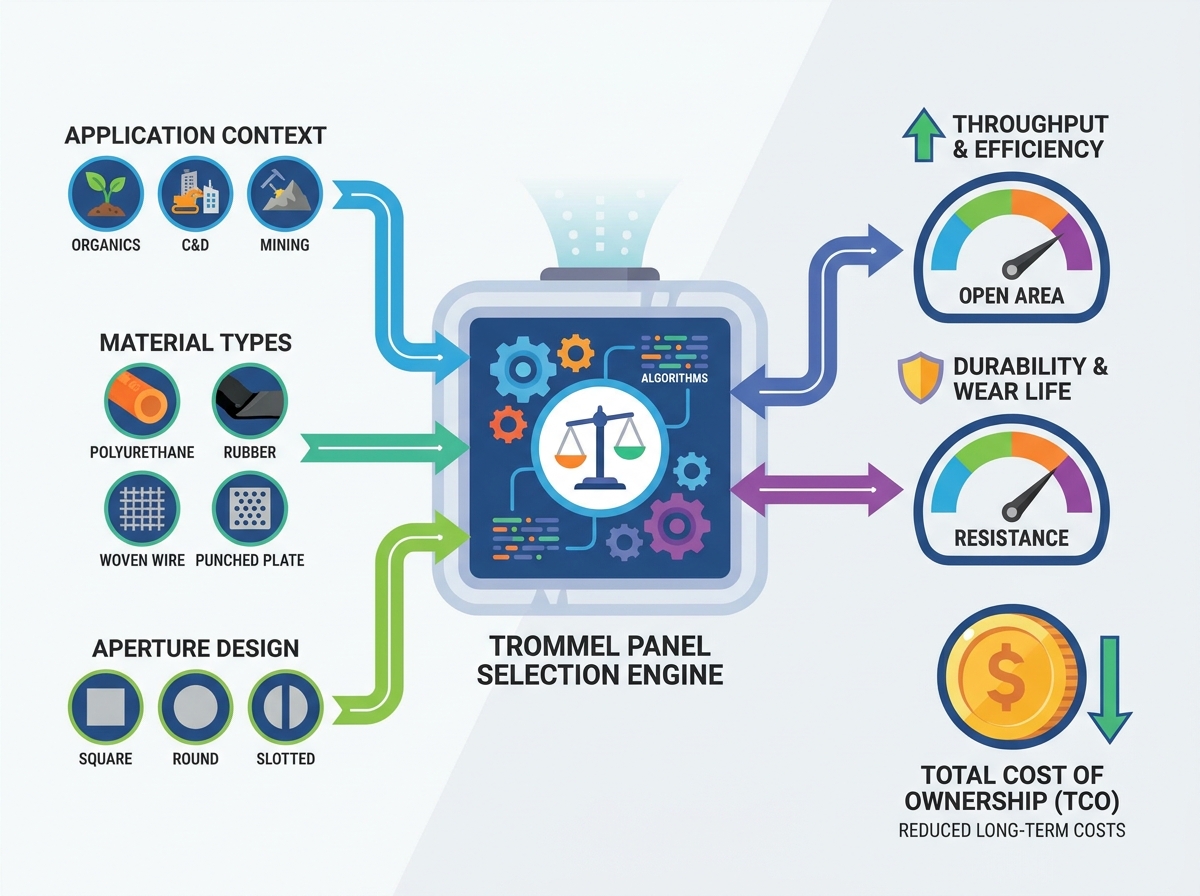
Square versus round holes represent a fundamental engineering choice. Square holes provide a much greater overall open area. They work best for sorting uniformly cubic materials quickly. The industry considers them standard for general sizing tasks. Round holes deliver maximum accuracy for specific sizing requirements. They prevent elongated, flat particles from slipping sideways through the screen. This guarantees stricter compliance with demanding product grading specifications.
Slotted and elongated apertures serve specific niche sorting purposes. Facilities use them primarily for high-moisture or sticky applications. Topsoil, compost, and mulch processing rely heavily on slotted designs. Blinding acts as the primary operational risk in these specific environments. The longer slots allow wet material to keep moving forward. The aperture shape flexes slightly to break up sticky clay clumps.
The open area equation dictates your absolute production limits. You must balance panel durability against maximum throughput capacity. Thicker bridges between holes significantly increase structural strength. However, thicker bridges directly decrease your open area percentage. You cannot maximize both factors simultaneously in standard designs. A careful compromise ensures adequate lifespan without choking your production line. Thin bridges process material faster but require frequent replacements.
Organics, compost, and green waste require specialized handling strategies. Your operational focus must center on moisture handling and material flexibility. Self-cleaning properties remain absolutely essential for continuous operation here. We strongly recommend polyurethane components constructed with slotted apertures. The flexible plastic material prevents sticky compost from bridging the gaps. It sheds damp soil effectively during each drum rotation.
Construction and Demolition (C&D) recovery presents brutally harsh conditions. Prioritize extreme impact resistance and structural durability above all else. Your screens must handle stray rebar, heavy concrete chunks, and jagged metal. Varied debris will destroy fragile wire mesh almost instantly. Punched steel plate or heavy-duty rubber serves this rough application best. They absorb the initial shock without tearing or deforming.
Mining and aggregates demand strict precision and extreme toughness. These environments require incredibly high abrasion resistance from all components. You must maintain precise cut sizes consistently throughout the shift. Strict product gradations dictate your final market value. Polyurethane or high-tensile wire mesh typically fulfills these rigorous demands. Polyurethane excels particularly when processing highly abrasive silica or granite.
We advise compiling specific data before consulting any manufacturer. Using a standardized approach eliminates guesswork from your procurement process.
Determine your average continuous feed rate and peak surge volumes.
Measure the maximum lump size entering the drum screen.
Calculate the average moisture percentage of your raw feed.
Define the exact desired cut size required for final products.
Modularity versus single-piece drums completely changes your maintenance strategy. We strongly advocate for modular systems wherever feasible. Swapping localized high-wear zones saves significant money over time. You avoid replacing entire drum screens prematurely due to isolated damage. Maintenance teams can replace damaged modular sections in minutes. This targeted approach maximizes the useful lifespan of undamaged sections.
Installation considerations heavily impact your overall plant uptime. Different fastening systems offer various advantages and unique challenges. Pin and sleeve mechanisms provide rapid, tool-free changeouts. Bolted systems ensure maximum security under extremely heavy rock loads. Tensioned setups require careful, precise alignment during the installation phase. Consider the specific downtime requirements for safe installation procedures. Securing mechanisms must absolutely protect your workers during maintenance shifts.
Proper training mitigates most common installation risks on site. Crews must understand torque specifications for bolted setups. Improperly secured components will inevitably detach during high-speed rotation. Loose panels lead to catastrophic equipment failure and extended downtime. Standardized installation procedures guarantee reliable performance and safer working conditions. Always inspect fastening hardware for wear during routine maintenance checks.
Specifying screen components requires careful, objective balancing of multiple variables. You must weigh theoretical throughput against practical daily wear realities. Daily maintenance demands cannot be ignored during the selection process. Always conduct a thorough baseline audit of your current equipment. Document existing wear patterns before ordering any replacement parts. This data highlights exactly where your current system structurally fails.
We urge buyers to consult with professional applications engineers directly. Bring your compiled feed gradation and throughput data to these meetings. This ensures an evidence-based selection rather than pure guesswork. Choosing wisely optimizes your process flow and boosts overall profitability. Upgraded materials and precise aperture geometries solve persistent bottlenecks permanently. Take the time to evaluate your unique operational environment carefully.
A: Replacement frequency depends entirely on specific operational variables. Material abrasiveness acts as the primary driving factor for wear. Hours of daily operation heavily impact overall component lifespan. The specific material type also dictates structural durability limits. We cannot provide an arbitrary timeframe for all operations. Monitor your screens regularly and establish a baseline replacement schedule.
A: Yes, operators frequently utilize zoned screening strategies successfully. You can install impact-resistant components at the initial feed end. This section handles the heaviest drops and largest rocks. You then place high-open-area components at the rear discharge end. Zoned screening optimizes both extreme durability and maximum throughput simultaneously.
A: Blinding requires an immediate shift in your equipment strategy. Transition to flexible polyurethane components designed specifically for wet environments. Incorporate slotted apertures to encourage continuous, uninterrupted material flow. The flexible nature actively breaks up sticky surface films. You can also add external cleaning brushes or rotating flails.
A: Theoretical capacity certainly increases with more open physical space. However, higher open area requires much thinner structural bridges. This directly decreases the overall wear life of the screen. Rapid wear results in more frequent maintenance downtime. Actual daily production often drops due to these constant maintenance stops.


