+86-173-0318-1768
- All
- Product Name
- Product Keyword
- Product Model
- Product Summary
- Product Description
- Multi Field Search

 |


| Quantity: | |
|---|---|
305x610 305x305
Our rubber screening panels are not ordinary molded rubber sheets. They are manufactured using state‑of‑the‑art rubber injection technology that ensures exact dimensional tolerances, uniform material distribution, and zero internal voids. Unlike compression‑molded alternatives, injection molding allows us to create complex aperture shapes, reinforced edge profiles, and integrated pin holes with repeatable accuracy.
- Consistent open area – Every panel delivers the same screening efficiency, batch after batch.
- Smooth surface finish – Reduces material adhesion and simplifies cleaning.
- Stronger bond between rubber and reinforcement – When steel or fabric inserts are required, injection molding encapsulates them perfectly.
Each panel is designed to fit a wide range of vibrating screens, trommels, and static grizzlies used in metal mines, aggregate quarries, construction recycling, and industrial mineral processing.
One of the most frustrating aspects of traditional screen media is the time spent removing bolts, cutting welded mesh, or wrestling with heavy frames. Our rubber screening panels solve this problem through a truly modular approach.
- Each panel comes with compatible pins (usually made of high‑strength polyurethane or rubber‑coated steel) that lock the panel into the screen deck frame.
- Installation requires no special tools—simply position the panel, insert the pins, and secure them with a light tap.
- Replacement is equally straightforward: remove the pins, lift the worn panel, and drop in a new one.
- Seamless integration – Our pin systems are designed to match common OEM decks (Metso, Sandvik, Terex, Powerscreen, etc.) as well as custom‑built frames.
- Quick installation – A two‑person crew can replace up to 50 panels per hour under normal conditions.
- Reduced spare parts inventory – The pins are reusable and durable, often lasting through multiple panel changes.
By minimizing the time required for screen media changeouts, our modular rubber screening panels help you maximize production uptime—particularly critical in 24/7 operations such as iron ore or copper concentrate processing.
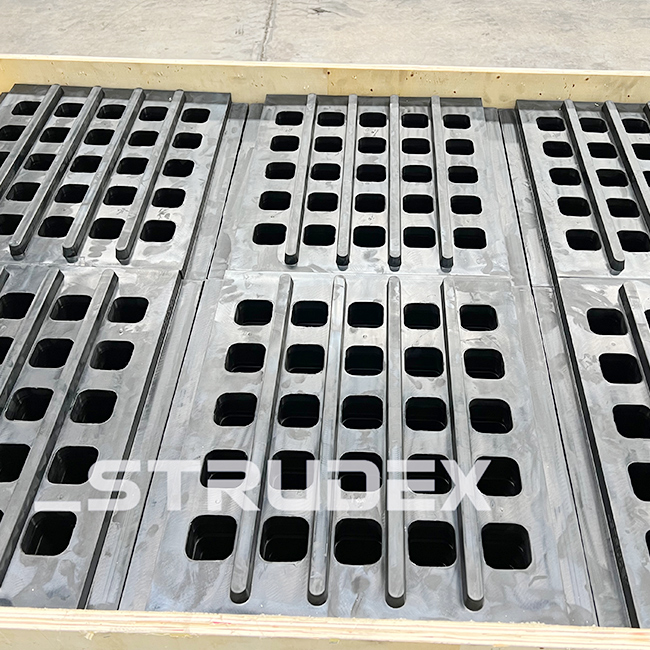
Rubber’s natural elasticity gives it a decisive advantage over steel or polyurethane in many screening applications. Our panels are formulated to maintain high elasticity even after months of continuous vibration and impact.
- Superior material stratification – The rubber surface “gives” slightly under the weight of heavy particles, then rebounds, creating micro‑movements that help fines pass through apertures more quickly.
- Impact energy absorption – When large rocks or ore lumps strike the deck, the rubber panel deforms elastically and returns to its original shape, dissipating energy without cracking.
- Reduced damage to downstream equipment – By absorbing impact, our panels also reduce the transmission of shock loads to the screen box bearings and structure, extending the life of your entire machine.
Unlike polyurethane panels that can become brittle in cold weather or under repeated heavy impacts, our injection‑molded rubber screening panels retain their resilience across a wide temperature range (standard grade: -40°C to +80°C; optional extreme grades: -50°C to +120°C). This makes them an ideal choice for applications ranging from frozen taconite to hot sinter.
Wear resistance is the single most important factor for screen panel total cost of ownership. Our rubber screening panels are formulated with proprietary wear‑resistant compounds that significantly outperform conventional rubber or wire mesh.
- Less frequent changeouts – Lower labor costs and fewer production interruptions.
- Consistent cut point – As the panel wears slowly, aperture dimensions remain stable, maintaining product quality.
- Less waste – Fewer discarded panels mean lower environmental impact and disposal fees.
We offer a range of rubber hardness from 40 Shore A to 70 Shore A, allowing you to match wear life with the specific abrasiveness of your feed material. For high‑silica ores or recycled concrete with rebar fragments, our 70 Shore A compound provides maximum cut and tear resistance.
Clogging (blinding) and pegging are chronic problems in many screening applications, especially when processing moist fines, clay‑bearing ores, or irregularly shaped aggregate. Our rubber screening panels incorporate unique anti‑clogging design features.
- Tapered apertures – The openings are slightly wider at the bottom than at the top, allowing wedged particles to work their way through rather than becoming permanently stuck.
- Dynamic flexing – Under vibration, the rubber apertures open and close slightly, “spitting out” near‑size particles that would otherwise lodge in a rigid screen.
- Smooth, non‑stick surface – The injection‑molded surface has a low coefficient of friction, reducing adhesion of wet or sticky materials.
Real‑world anti‑clogging performance:
- In a Florida phosphate mine (wet, sticky feed), our rubber panels reduced blinding incidents by 85% compared to steel screen decks.
- In a Scottish aggregate quarry processing damp sandstone, screen throughput increased by 30% after switching to our anti‑clogging rubber panels because operators no longer had to stop production to rod out blocked apertures.
By eliminating frequent cleaning stops, our rubber screening panels save valuable time and resources. The result is a smoother, more predictable screening process with higher overall equipment effectiveness (OEE).
Choosing the right screening media is also an environmental decision. Because our rubber screening panels last 2–5 times longer than conventional alternatives, you generate significantly less waste over the same production period. In addition:
- The rubber compounds used are recyclable through industrial tire‑recycling channels.
- Extended wear life reduces the carbon footprint associated with manufacturing, packaging, and transporting replacement panels.
- Lower downtime means less energy wasted during idle periods of upstream and downstream equipment.
A Midwest U.S. aggregate producer replaced their polyurethane panels (4‑week lifespan) with our 60 Shore A rubber panels (24‑week lifespan). Despite a slightly higher upfront cost, their cost‑per‑ton screened dropped by 62%, and they eliminated 5 changeout cycles per year.
Strudex Tech is not just a supplier; we are a process optimization partner. When you invest in our rubber screening panels, you receive:
- Comprehensive technical support – From selection to installation to performance tracking.
- Custom manufacturing – Any aperture size from 0.5 mm to 150 mm, any panel dimension up to 1200 × 1500 mm.
- Fast turnaround – Stock panels shipped within 48 hours; custom orders typically completed in 10–15 business days.
- Full range of mining spare parts – Beyond screen panels, we provide rubber liners, conveyor skirting, mill liners, and wear plates.
Our promise: We will help you find the most productive, sustainable, and cost‑effective solution for your application. Whether you are a large‑scale mining operation or a small quarry, our professionals are eager to assist.


